Posts

Showing posts with the label Orbea

A New Year stink: Orbea semota var. lutea

Image
Here before us is what has been called Orbea semota  var. lutea , a popular version of O. semota with vibrant yellow flowers- ' lutea ' means 'yellow' in Latin, specifically a deep yellow one sees in buttercups. However, this name appears to only circulate these days among the horticultural community, as color forms hold no taxonomic value- but we'll get to that. Thus, the name O. semota  var. lutea  is now only a synonym of O. semota . Or so the gods at the hallowed halls of Kew say. This form is said to have been originally found near Nairobi in Kenya, growing on rock outcrops. A fly moves into the flower to lay its eggs, which immediately hatch into writhing maggots. This flower opened last Dec. 30. Color forms really aren't distinct from the normal ones- except of course for the color. This is the reason why in the taxonomic discipline, such differences are not given separate status such as variety or forma  (this latter designation is the ...

The dark and brooding Orbea baldratii subsp. somalensis

Image
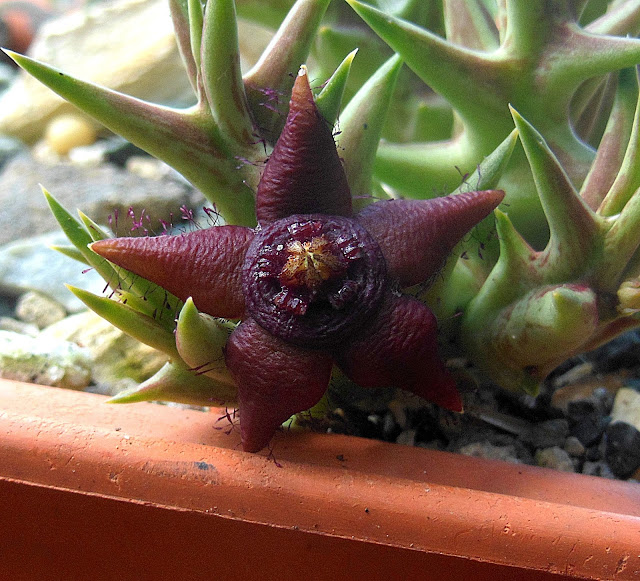
Acquired last November as Orbea baldratii and   as a single-stemmed, unrooted cutting, this plant has grown exceptionally well and by early January managed to produce a single flower. Comparison of the flower to photos circulating on the web suggested that what I have is subspecies somalensis , endemic, as its name suggests, to Somalia*. The nominate subspecies, subsp. baldratii , is known from Eritrea and Sudan, but is said to also probably occur on neighboring regions. In the subsequent months the plant puts out a flower or two, but blooming is very unpredictable, and there have been occasions where I would only detect the presence of a flower only until it has faded. The flowers have very narrow corollas made even narrower by the margins reflexing and meeting at the rear. The surface is finely papillate and blackish-purple. Buds often go unnoticed as these are pointed and of the same color as the stems. As is usually the case with many stapeliads, the flowers emit a rot...

A flower with a very 'manly' scent

Image
Orbea abayensis was described in 1978 Michael George Gilbert, but as Caralluma abayensis . Peter Vincent Bruyns transferred it to Orbea in 2000. The species name was derived from Abay River in Ethiopia, the so-called 'Blue Nile'. These plants occur on ledges on alluvial soils deposited above gypsum, at elevations from 1200-2300 m above sea level. Alluvial soils are often loamy with very fine sand components and carried by flood waters to be deposited many miles further, when the flooding subsides. Such soils are highly fertile. Compared to many other stapeliads, O. abayensis appreciates more moisture, with its soil preferably more loamy and nutrient rich, and calcareous. However, these plants are very amenable in cultivation using other substrate materials, for as long as it is not overly laden with organic matter, or there is risk of plants rotting or stems collapsing from too much stored nitrogen. My plant is maintained in a purely inorganic mix in full sun, and water...

The starfish-like Orbea dummeri

Image
Hailing from East Africa, Orbea dummeri is one of the most well-known of the stapeliads, with flowers that look more like sea creatures with bear-trap maws and tentacled arms than anything else. Their ease of growth and free-flowering habit also contributes substantially to their popularity worldwide. These plants bloom during spring to summer, sometimes extending up to early autumn. Note the inward-pointing trichomes around the corona. These may serve to facilitate the entry of potential pollinators to the vicinity of the corona, but dissuade them from leaving too soon, forcing them to linger on the corona and therefore increasing the likelihood of them picking up a pollinia or effecting pollination. Because it's from equatorial climates, O. dummeri is very easy to maintain in the tropics. The plants can withstand very harsh conditions, from full sun and prolonged periods of drought, to heavy rains. The plants are better off sheltered during tropical typhoons, however. ...

Orbea semota subsp. orientalis and its lovely scent of poop

Image
A native of Niger in the north, and Kenya and Tanzania in Central Africa, Orbea semota subsp. orientalis is distinguished from the nominate subspecies, O. semota subsp. semota , by its smaller flowers that are unadorned with blotches. The corolla lobes are rugose (with a roughened texture) and edged with clavate (club-shaped, or with the tips thickened) vibratile trichomes that move in a creepy way even at the slightest breeze. These trichomes are relatively longer than those from subsp. semota , but fewer in number. The annulus (that lifeguard-shaped structure at the center of the flower) as well as the corona are moistened. Dare I say that if touched, its lovely scent of feces will stick to your intruding finger. I repeat: feces. In a public toilet, to be more specific about it. The flower is 2.5 cm across and unsurprisingly evolved to attract flies, its main pollinators. Even the color is insipid enough to recall the coloration of exposed and shriveling flesh of a dead animal fes...

A rocky argument

Image
And so after a visit to a garden center or a mall, you found a commercially made potting mix and promptly bought it, to be used as media for your succulents. Upon reaching home, you take a photo or two of the product and post it on social media, asking people if what you have purchased is suitable for use for succulents (which makes mo sense at all, considering that you already bought the said product. You are just committing what is termed as confirmation bias- in your mind you were convinced that you were correct in your decision, and would like others to have that supposition confirmed, which feels good). Predictably, answers you obtained are just variations on a theme: that the potting medium you have at hand, which is coconut coir based, is perfect for cacti and succulents, but you need to add some specific amount of sand and/or pumice to make the mix free draining. Satisfied with the answers to your query, you picked up the cutest pots for your plants, had them potted up, and f...