Posts

Amorphophallus salmoneus x A. macrophyllus 'Bluto': Will you or will you not?
Image
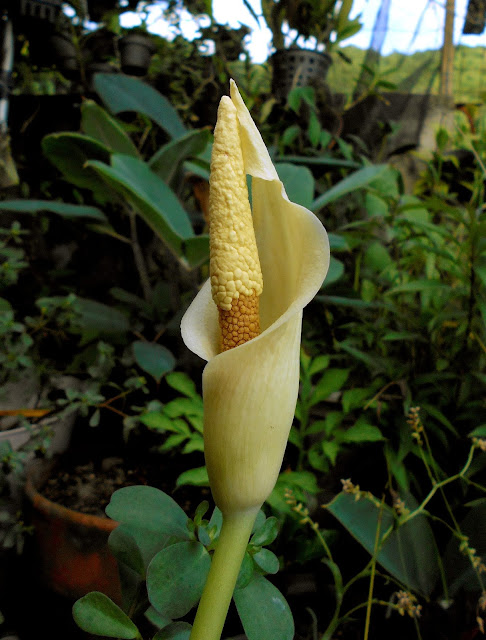
Today, the male flowers of Amorphophallus salmoneus began shedding pollen, coinciding with the receptivity of the female flowers of one of my many A. macrophyllus 'Bluto'. You know what that means. Frankly, I am not sure if this endeavor will 'take'. I always felt that the former genus Pseudodracontium  (of which macrophyllus is a member of) is sufficiently distinct from Amorphophallus to stand as its own genus, which is another way of saying that there is a possibility that I just wasted my time. Of course, plants from two different genera can be artificially crossed, but there are many cases when they just won't. However, I am prepared to be surprised. And I want to be wrong. For those wondering why I think Pseudodracontium might be distinct from Amorphophallus , the answer lies in their more verrucate appendices AND the fact that contrary to most Amorphophallus , the inflorescences are synanthous. What the latter means is that the peduncles appea...

Amorphophallus salmoneus and... is the climate changing?

Image
If you have been following this blog for quite some time, you may have already anticipated this: posts about Amorphophallus  come out during late spring or early summer. However, this post comes a bit earlier than usual. Because whereas the rains habitually announce their return during May, triggering the beginning of the year's activity period which manifests a couple of weeks later, this year's precipitation fell in April. Strange, considering that April is THE driest month in my area. Memory tells me that I have never seen a raindrop fall in April. Ever. Now, this would have been quite a trivial matter to discuss, even briefly, but since last year, I have been noticing rather strange Amorphophallus behavior coinciding with the prevailing climate. Some of my plants woke up very late- around the end of July and early August. And while most of them entered slumber during November and December- which is typical- there were those that lasted until February; one of my  A. bu...

A process of becoming.

Image
Early 2018, I purchased a plant of Gymnocalycium anisitsii subsp. damsii , a very common and inexpensive cactus that is available practically anywhere in the Philippines. It was acquired mainly for experimental purposes; these past years I have been trying to emulate the appearance of wild plants by using purely- yes, 100%- inorganic, mineral mix. No soil, just rocks. I was inspired by photos of wild plants in their natural habitats and the interest coincided with a paradigm shift wherein mainstream 'knowledge' relating to cacti mix have been totally thrown out of the window in favor of a much more natural way to grow these plants. Anybody who has spent a fair deal of time cultivating cacti surely knows what G. anisitsii subsp. damsii looks like: dark green, plump cacti with short and thin spines and  prolifically surrounded by pups. The plant I bought is typical of these store-bought varieties. Upon returning home, I immediately removed all the pups, potted it in a purely m...

The unusual and majestic Rhaphidophora monticola

Image
The current popularity of aroids around the world has brought into spotlight several previously obscure species of the species-rich Anthurium as well as Philodendron and Monstera. This triumvirate of Neotropical aroids form the bulk of Araceae found in very many private collections worldwide, but monsteroid genera from Asia, particularly Rhaphidophora , are increasingly being regarded as worthwhile subjects too, especially the widespread and very variable R. korthalsii . In the Philippines, one species stands out among all the other known species to date, but is virtually unknown in horticultural circles- R. monticola . Rhapidophora monticola was described (as ' Rapidophora monticola ') in 1910 by Kurt Krause in Botanische Jahrbucher fur Systematik, Pflanzengeschichte und Pflanzengeographie (Botanical Yearbook for Systematics, Plant History and Plant Geography) based from specimens collected by A.D.E. Elmer in Cuernos Mountains in Dumaguete, Negros Oriental in June, 19...

A white, 'salty' Hoya

Image
About a decade ago, some plants of a supposedly albinistic Hoya pubicalyx became available from a few orchid peddlers in the province of Quezon, and were being offered for rather exorbitant prices. Not too long thereafter, the plants were visited in its area of discovery by George Mendoza, a plant collector, and the plants he collected were sent abroad, which formed the bulk of the plants eventually propagated in Thailand, Sweden, and the US. Meanwhile, the plants were very rarely seen in its country of origin. I have been to the type locality of this species, and contrary to what was given in the protologue, the plants were not found in the town of Mauban, but in Real. Here also is the locus classicus for Begonia polilloensis . The area where Hoya celata was found in 2010 is characterized by cliffs facing the sea but is now heavily degraded due to a road being constructed, although recent visits proved that plants still persist, particularly on the higher reaches. However, si...

Graceful Crinum gracile

Image
About one-and-a-half years ago, I was given a small plant of Crinum gracile which I potted in gritty soil and placed in partial shade. The plant grew steadily, yet slowly even with regular fertilizer application, until I finally noticed a peduncle forming near the base. As with practically all crinums, the inflorescence developed rapidly, and two nights ago, the first two flowers opened, at night. Crinum gracile is one of only two native representatives of the amaryllis family ( Amaryllidaceae ) in the Philippines. It has been found in Nueva Ecija, Rizal, and Laguna provinces in Luzon, and the islands of Mindoro and Mindanao, although there seem to be no existing precise locality records for the latter two islands. It is also found in Sumatra and New Guinea. Compared to the much larger and more robust C. asiaticum which is widespread around beaches, C. gracile appears to be rare and localized plants, at least in the Philippines. As such, it is barely known in cultivation. It ...

The sweet and tiny Trachoma phillipsii

Image
I would like to lead myself into believing that I already have way too many plants, which should explain why, since November when I started seeing spent flowers of these plants, I have not seen the floral display at the height of its anthesis. But no, I think it's just a plain case of inattentiveness. Nothing more, nothing less. Because you see, Trachoma phillipsii is one of my (very) small-flowered orchids that when in bloom, are just very likely to drown unnoticed in a sea of green. I have seen batches of buds about to pop, only to miss the show and realize the boo-boo a day after, after seeing the flowers already closed. You see, the blooms, cute and attractive as they are, only last for a day. Trachoma phillipsii was described by Timothy Choltco (as Tuberolabium phillipsii ) in 2007 and was named in honor of Andy Phillips, the well-known orchidist from California and the importer of the plants from where the original description was taken. The flowers are barely a cen...