Posts

Is Borneo Exotics' Nepenthes aenigma the real thing?

Image
In recent months I have been seeing the recently described Nepenthes aenigma  being offered for sale by well-known Nepenthes producer Borneo Exotics, and have had a few people ask me if these are the real thing. A link to their price list can be seen here:  http://www.borneoexotics.com/files/availability.pdf If you have read the description you will see that we had a very difficult time searching for female plants, and all plants from Site 1 were males, with no sign of seedlings. I even proposed in that paper that this population is most likely on its way to natural extinction. Site 2 had a small population and on our last expedition dated May 22-23, 2015, we attempted to traverse the mountain to be able to observe both populations in one, single trip but the team was met by an impenetrable summit vegetation drenched by driving, metallic rains: Site 2 is supposed to have at least one female plant, but the population is also extremely small. Note that on th...

A very dark variant of Begonia nigritarum

Image
Begonia nigritarum is one of the most widespread Begonia species in the Philippines, with so many variations in leaf color and size, and rhizome behavior. Most variants have marked leaves and creeping rhizomes, but one population within my area exhibit very dark leaves that blend with the dark volcanic rocks the plants cling on. Additionally, the rhizomes are very short and compact, which is probably explained by the deciduous nature of the plants. If these plants weren't so, the rhizomes have the potential to elongate indefinitely and will be limited in their length only by age. During the dry months, the plants die back to dormant rhizomes which are protected from further desiccation because these are tightly appressed on the underlying rock. That the plants are in shaded locales help too; I have never seen the population ever receive direct sunlight, irrespective of the time of the year. Other plants of this species from other populations also experience a dry perio...

The flamboyant Gloriosa superba

Image
This is one of the earliest plants I acquired since I started keeping plants, and may have been in my possession since the early 2000s. Despite it being rather common in collections worldwide, Gloriosa , or fire lilies as they are often called, is seldom available in the Philippines and its dormancy period may have contributed to a less appreciative outlook on the part of many casual gardeners. Gloriosa has scrambling, brittle stems that are supported by the twining tendrils of the leaf tips, similar to those found on Nepenthes , although not developing any further into a modified organ. The mature stems branch at the apex and it is where the flowers appear. As the flowers ages, the yellow portions deepen in coloration. The exuberant architectonic design of Gloriosa . Gloriosa propagates asexually by means of daughter tubers which are curiously V-shaped, with one end longer than the other. I had these plants planted on the ground in my former residence, where th...

How to tell Grammatophyllum multiflorum and G. scriptum apart

Image
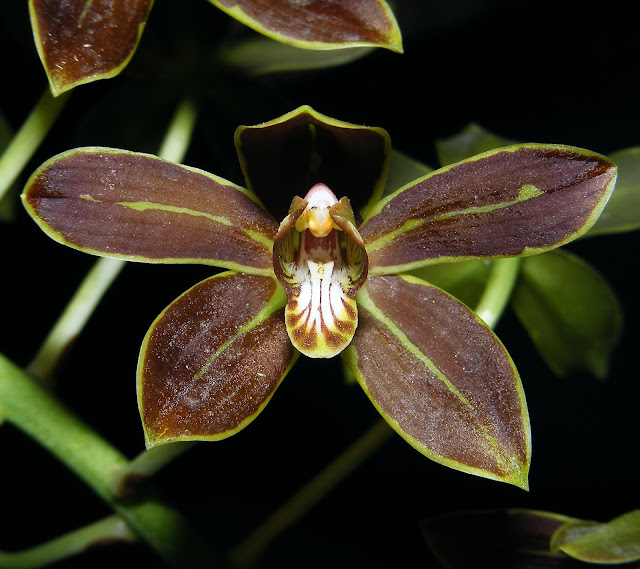
From observations, many orchid collectors here and abroad still confuse two similar-looking Grammatophyllum species, G. multiflorum and G. scriptum . Indeed, the popular G. multiflorum fma. citrinum is still labeled as G. scriptum var./fma.  citrinum in many collections and orchid shows around the world. But is the confusion warranted? In this post, we will compare the two taxa and discuss the characters that you, the orchid collector, can use to distinguish the two. So get your new tags and a pen ready. Grammatophyllum multiflorum This is a species endemic to the Philippines and widespread on southern Luzon, and has been found on the western islands of Mindoro and Palawan as well as Leyte and Samar in the Visayas. This is the most commonly encountered Grammatophyllum species on Luzon. The flowers are usually around 5 cm in width and mainly dark brown with a pale green median line and edges. If you look closely at the labellum you will see a median ridge surrounded by...

A verbena's open invitation to a feast

Image
The fragrant garden plant Aloysia virgata , often called 'verbena', blooms practically all year round but it is mostly during the onset of the rainy season that it attracts a wide range of insects, particularly butterflies. And along with them also come other nectar-seekers and predators taking advantage of the congregations. Fortunately, none of my cats ever bothered with any of the fliers and so the visitors were left on their own devices free from any aggravations.  I believe this to be Scalloped grass yellow ( Eurema alitha jalendra ). I could be wrong though, and it may even be  Gandaca harina. During this time of the year, butterflies and other nectar seekers become so absorbed feeding that they can be approached quite easily. Even those that fly away upon your arrival comes back to the flowers almost immediately.  The candy-scented flowers of Aloysia virgata Lepidopterans, the butterflies and their moth cousins, consist t...