Posts

Showing posts with the label Amorphophallus

My (bitchy) aroid mix

Image
 Through the years, I have experimented with a wide range of soil ingredients- from loam soil, sand, coco chunks, coco peat, burnt rice hulls... practically everything you can think of. And while these components can be suitable for most plants, the mix just won't cut it for more specialized aroids. Everyone have their own recipes that they swear their lives on. However, I have found out- through trial and error as well as years of experience- that my 'tried and tested' mixes even from just a few years ago have resulted in the demise of some choice plants. Plants that are extremely difficult to procure here in the Philippines where horticulture is not as well-developed as its neighbors. I needed a mix that would greatly minimize, if not eliminate, the odds of losing more plants. Incidentally, what I have come up with is very similar to those used by aroid growers in Europe. And by 'aroid growers', I am not referring to the mainstream crowds who like what their next ...
An eleven-year itch

Image
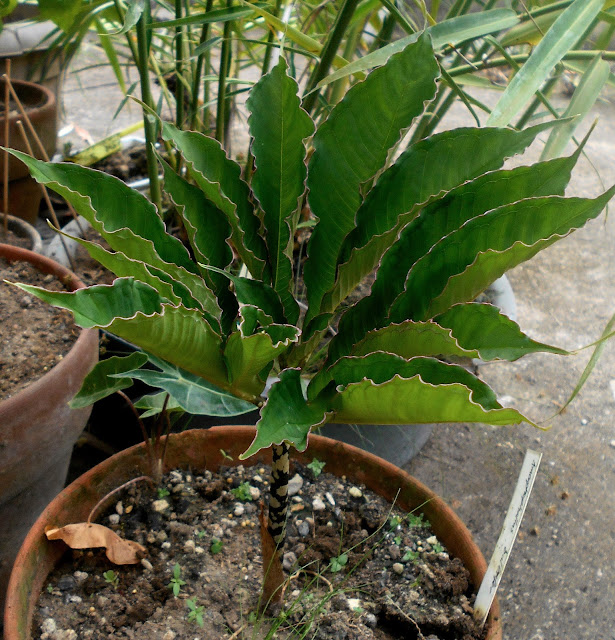
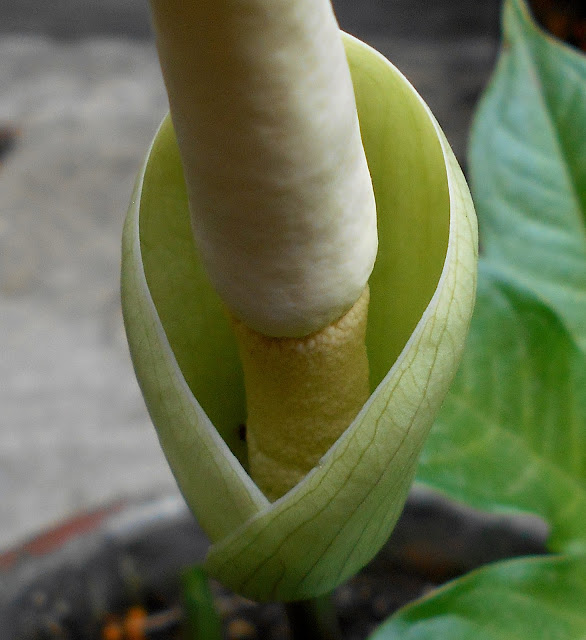
The original plant was given to me by Andreas Wistuba in mid-2010, and has since proven to be a very forgiving species, withstanding neglect, bad soil, even worse weather, and terrible water quality. However, as vigorous and adaptable the plant is- it has since given rise to countless offsets which have been released to a handful of collectors from the Philippines- it failed in the flowering department, until now. That is a record-breaking, hair-pulling eleven years of waiting. I probably would have flowered an A. titanum from seed much sooner. These are rather small plants seldom attaining heights in excess of a foot, with gray-brownish petioles finely striped longitudinally with dark brown. The leaflets are minimally divided, and one thing I have noticed, which was not mentioned in the original description, is that the leaflet surfaces have a somewhat iridescent surface, turning bluish-green at a certain angle from the light. After each growing season, the smooth corms give rise to ...

Amorphophallus urceolatus in habitat

Image
The first time I saw these plants was in 2001, and I remember being struck at how different these were from the stands of Amorphophallus paeoniifolius that were growing at the entrance of the forest, in poor and gravelly soils. These bear strikingly glossy leaflets and smooth petioles that were very much unlike the tuberculated ones in  A. paeoniifolius . Their ecology is also very different, preferring more shade and growing amongst leaf litter and humus, often on slopes. Years later, a friend intimated to me that some taxonomists were interested in describing these plants as ' Amorphophallus urceolatus ' a nomen nudum until the species formal description in 2020. The habitat is lowland riverine forest in the province of Laguna on Luzon at about sea level. The banks are flanked by rocks and large boulders. Remnants of felled down trees, likely dipterocarps, still remain. I have been seeing these since the early 2000s and judging by the state of the stumps, I reckon that these...

Of philosophy and Amorphophallus

Image
"The two most powerful warriors are patience and time." -Leo Tolstoy Ask anyone who grows aroids and are therefore familiar with Amorphophallus   but would not want to grow Amorphophallus,  and you'll receive these two answers the most frequently as to why they don't and won't: they stink and they go dormant. The odor of the inflorescences in most species is a given. However, there are those with rather fragrant odors and there are those that are innocuous, scent-wise. And yet, these same plants are still nowhere near as commonly cultivated as any other aroid. Besides, most Amorphophallus species bloom very unpredictably and infrequently; an Amorphophallus in flower is an event of its own like I said numerous times previously. When a plant you have had for a decade flowers for the first time, you really would not worry about the olfactory assault, would you? The bloom will last for just a few days, to be repeated for who knows when- another decade, perhaps? ...

Introducing, Amorphophallus merrillii

Image
A month. That is how long it took before the tiny green nub emerging from the soil line finally became a fully formed inflorescence with spathe open for business. What usually happens with Amorphophallus species with tall peduncles is that you usually won't be able to tell if you will be getting a leaf or a 'flower' until a spathe breaks free from the cataphyll- that's nerd-speak for the leaf-like organ that is wrapped around a developing leaf. Cataphylls rot away as the leaf prepares to unfurl. In the case of this plant, I was finally able to tell that an inflorescence was on the way about two weeks after the plant broke dormancy. But patience comes in the territory of Amorphophallus cultivation. Amorphophallus merrillii was described in 1912 by Kurt Krause from a flowering specimen collected by Elmer Drew Merrill on the island of Cavilli in September 1910; in the protologue, Krause noted: "sehr häufig in Wäldern (very common in forests). Elmer Merrill, i...