Posts

Showing posts with the label Phalaenopsis

A 'cleaner' Phalaenopsis stuartiana
Image
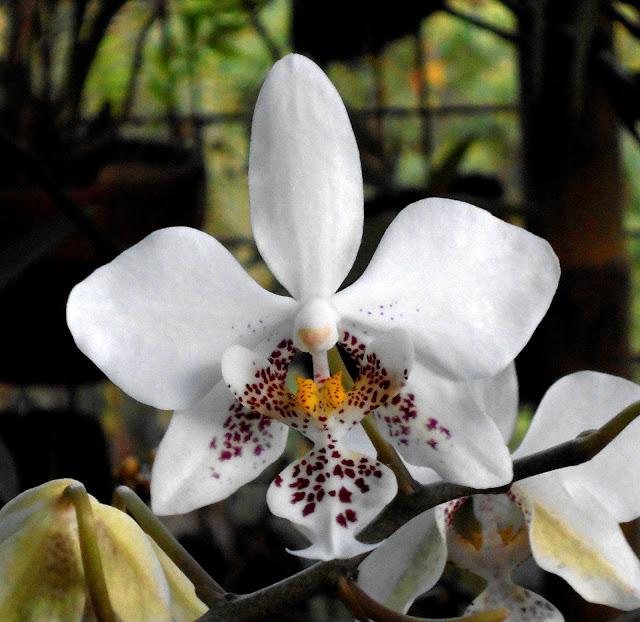
Okay, tell me how many times you have seen something like this. Typically for Phalaenopsis stuartiana , the inner halves of the lateral sepals and the labellum midlobe are pale yellow overlaid with dark maroon spots. One of my plants here of this species deviates from the norm by exhibiting no such yellow coloration, the yellow being confined only to the callus and the labellum side lobes, resulting in a 'cleaner' look. Compared to many other stuartianas, this clone begins its flowering period by producing a batch of few buds, with the rachis elongating progressively with more flowers.  Don't read me wrong: I like even normal stuartianas, but I just can't deny that the more ascetic look of this one has a more, shall I say, regal air to it. Can't wait for more of those flowers!

Phalaenopsis schilleriana and P. stuartiana as one species?

Image
Recently, my attention was drawn to an article which appeared at the Manila Bulletin dated May 2, 2017 and authored by Jim Cootes and Ronny Boos, two personalities whose names are frequently mentioned with regards to the study of orchids in the Philippines. In that article, it was implied that Phalaenopsis schilleriana and P. stuartiana may possibly be one species, with the latter being a variant, as the former was earlier described. It's been years since I talked to these authors about orchids, but if the reverse was true, then I would have advised them that such a supposition is, well, quite absurd. But first, here is a link to the said article: https://newsbits.mb.com.ph/2017/04/30/the-curious-case-of-phalaenopsis-schilleriana-and-phalaenopsis-stuartiana/?fbclid=IwAR1BMepvNb0W8_ckMBDohUNTMkVaonQY1oxs7bJNDf6v8R2xxbuAUJ3mRHk What I did notice at the said article is that the authors failed to take into consideration the shape of the callosities of both species, and their disti...

Something strange happened this morning

Image
Earlier today I was feeding my plants of Phalaenopsis schilleriana with a high potassium fertilizer to prepare them for their February to March show, a flowering event that takes place only once a year and has become a source of constant early year anticipation for me. With those pink, fragrant flowers, who wouldn't? Most of my schillerianas are on the second floor of my house, while there are only two on the uppermost level, one of which is still too small to bloom. Except for the small one, all my other schillerianas have inflorescences already peeking out, or at least that is what I think. One of the quirks of this species is that these plants will often send out spikes which terminate not with buds, but a keiki, much to the consternation of many growers. This often happens when a plant is denied a cooling period prior to the expected flowering season, but even in areas with the correct climate, schillerianas will dish out an unamusing joke on you that’s one year in the mak...

Variations in Phalaenopsis pallens

Image
Phalaenopsis pallens  was first described as a species under Trichoglottis by John Lindley in 1850 and then was transferred by Heinrich Reichenbach f. to Stauropsis in 1860. But four years later he changed his mind and moved Lindley's species to Phalaenopsis , where it remains to this day. The species is endemic to the Philippines on the islands of Luzon (Bataan, Bulacan, Nueva Vizcaya, and Rizal), Palawan (Puerto Princesa), and Mindanao (Bukidnon). This is a low altitude species that occurs at elevations of about 200-500 m above sea level. The species name is Latin for 'pale'. In this post, I am presenting to you some of the variations seen in the species. The specimen above is quite typical with pale, sienna-colored markings and a white and orange labellum. Contrast that to the two examples below, with (brown-) reddish broken lines and a labellum in orange, purple-pink, and white.: This P. pallens  have more pronounced markings that fade to brownis...

Kingidium philippinense is not the same as Phalaenopsis deliciosa

Image
In my previous post on Phalaenopsis , I made mention of what I perceive to be an error in referring Kingidium philippinense as a synonym of Phalaenopsis deliciosa . Today I will discuss why, without diving into systematics. Shown below is Kingidium philippinense , and below it, P. deliciosa . The immediately obvious difference between the rachises of both species is that it is branching on the former. Indeed, I am yet to see a flowering plant of P. deliciosa with branched inflorescences, whether live or in photos. Of course, there is that odd chance that someone is going to show me a photo or two of a deliciosa with branched inflorescence, but the two are separated more than by that character. The lateral sepals of K. philippinense are oriented horizontally, while those of P. deliciosa  are decidedly drooping. The labellum midlobe of K. philippinense  is cuneate (wedge-shaped), but it is flabellate (fan-shaped) in P. deliciosa . The two-pronged callus have an extr...

Phalaenopsis: a photographic compendium of Philippine species

Image
The genus  Phalaenopsis  requires no introduction, and its species, in their myriad variations and color forms, are still much sought around the world even after more than a century of introduction. And for this post, I present to you the Philippine species which are among the most spectacular in the genus. Phalaenopsis amabilis Phalaenopsis amabilis labellum Phalaenopsis amabilis , albinistic form Phalaenopsis aphrodite subsp. aphrodite Phalaenopsis aphrodite subsp. formosana Phalaenopsis intermedia Phalaenopsis intermedia, red lip Phalaenopsis intermedia, yellow lip Phalaenopsis intermedia, pink form Phalaenopsis philippinensis Phalaenopsis sanderiana Phalaenopsis sanderiana Phalaenopsis schilleriana Phalaenopsis stuartiana Phalaenopsis stuartiana fma.  nobilis Phalaenopsis  x  veitchiana Phalaenopsis equestris Phalaenopsis...