Posts

Showing posts with the label Cacti and succulents

The succulents went silent

Image
 Just a few years ago, succulents were the horticultural world's kings. Now, they're in the backseat, unceremoniously dethroned by the new royalties- the notorious aroids. What happened? In a nutshell: Aroids and COVID-19. But we are getting ahead of ourselves. In the years prior, up to 2019, succulents were the darlings of collectors and a sure money-in-the-bank for the great majority of growers. Everybody were hooked, from the most rabid squirrels to the greenhorns, from interior designers to casual shoppers who only chanced upon some whilst doing their rounds around the metro. Succulents are an informal group, encompassing an impressive range of families from the mighty Cactaceae to the ubiquitous Crassulaceae and Euphorbiaceae to the curious stapeliads from the family Apocynaceae , to specialized Aizoaceae . And then there are the caudiciforms and the honorary succulents from otherwise non-succulent families, such as in those of the Asparagaceae , Bromeliaceae , Gesneriace...

A process of becoming.

Image
Early 2018, I purchased a plant of Gymnocalycium anisitsii subsp. damsii , a very common and inexpensive cactus that is available practically anywhere in the Philippines. It was acquired mainly for experimental purposes; these past years I have been trying to emulate the appearance of wild plants by using purely- yes, 100%- inorganic, mineral mix. No soil, just rocks. I was inspired by photos of wild plants in their natural habitats and the interest coincided with a paradigm shift wherein mainstream 'knowledge' relating to cacti mix have been totally thrown out of the window in favor of a much more natural way to grow these plants. Anybody who has spent a fair deal of time cultivating cacti surely knows what G. anisitsii subsp. damsii looks like: dark green, plump cacti with short and thin spines and  prolifically surrounded by pups. The plant I bought is typical of these store-bought varieties. Upon returning home, I immediately removed all the pups, potted it in a purely m...

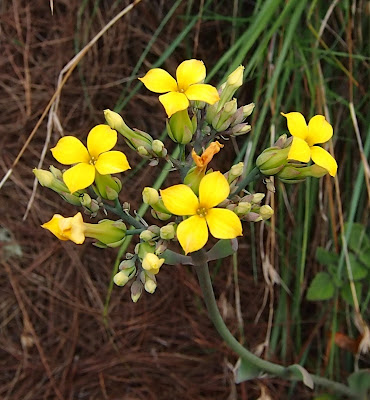
Kalanchoe spathulata, a native Philippine succulent

Image
As one might expect, the succulent flora of tropical regions are rather depauperate compared to those in more arid climates further north or south of the equator. However, families of primarily succulent plants persist even in the tropics, notably the Crassulaceae , which encompasses well-known succulent genera such as Crassula and Echeveria . In the Philippines, two genera are present- Kalanchoe and Sedum . The former was very poorly understood until quite recently, and many thought that plants found in a wild state in parts of the archipelago were escapees from cultivation, notwithstanding the fact that the plants seen farthest from human settlements all bore yellow flowers and thus lending suspicion that all were from the same species. Perhaps the most popular species in cultivation, K. blossfeldiana , has not been found in the wild despite its prevalence in gardens around towns. Three  Kalanchoe species that are not native to the Philippines which have established feral ...

The ultra-simplified succulent soil mix

Image
"The ability to simplify means to eliminate the unnecessary so that the necessary may speak", said German-American painter Hans Hofmann, who was a major influence in the development of abstract expressionism. His patches of pure color are severe and express and represent nothing but themselves alone. Thus, blue is freed from associations: blue isn't about a blue sky anymore. Blue does not exist because of the sea. Blue represents nothing but blue and it is up to the spectator to draw up comprehensions and emotions about it. Meanwhile, Henry David Thoreau admonished our inclination to complicate: "Our life is frittered away by detail... simplify, simplify." The mantra to break down things into its simplest form carried on even to my gardening, and nowhere is this most expressed than in my approach to preparing soil mixes for my succulents. If you have been following my writings in this blog, then you probably already know that I have been to the same phase a...

Full sun vs full sun

Image
The one on the left receives direct sun from about 12 PM to sundown. The one on the right gets full sun from around 7 AM till the sun vanishes from the horizon. As far as insolation is concerned, both plants benefit from direct sunlight, and yet the results are vastly different. Because as you can see, not all "full sun" are equal. A week ago, I saw a post on Facebook about an Echeveria 'Black Prince' that appears etiolating, with conspicuously brightish green leaf bases. According to the owner, her plant receives "full sun", but having seen hundreds, if not thousands, of succulents, I know what "full sun" does to plants. And her plants certainly do not fall into the category. When I inquired about the length of time, she said it's 8 hours. My plants (when pertinent, because this logically excludes the ones that prefer more shade) receive roughly 11 hours of full sun every day. It would have been more if not for the mountain range th...

Creating the indestructible cactus

Image
If it's any gauge, the number of people I see on social media lamenting about their cacti turning into masses of jelly says that even with the more commonly available types, there is still a great deal of misunderstanding regarding the growing of these otherwise easily cultivated plants. And if many hobbyists, particularly the beginners, can't even get past the more standard types, then how can we expect the cactus scene to develop further? In many plant bazaars, I frequently see people huddling over some rather pricey specimens only to overhear them say "I can't even keep most of my cacti alive, so if I buy that, it would just be like throwing away my money." It's not atypical to find stalls still displaying so many of their offerings on the final day of a plant show. And no, it's really not about the price of these plants as even the more expensive ones are still within the range of most collectors. It's about the experience of the vast majority of...

Another Stapelia NoID

Image
I received this plant as Stapelia grandiflora back in November 2017 and bloomed a year later, when the plant has already developed into a sizable clump. Upon seeing the first flower, I was immediately under the impression that the identification was incorrect, and was reminded instead of S. unicornis , a species similar to the popular S. gigantea , but with smaller flowers and a bowl-like interior. Today, two flowers opened simultaneously, and I am still not sure what this could be. Stapelia unicornis is so-named by virtue of its inner corona lobes that are in contact with one another and giving the impression of a central horn. I could not find this feature in the flowers on my plant, although it does share the erose (appearing as if gnawed) margins. I must suppose then that this plant is possibly a hybrid involving S. unicornis  and probably  S. gigantea . It has the stem proportions and bowl-like flower interior of the former, with the prominent transver...

A New Year stink: Orbea semota var. lutea

Image
Here before us is what has been called Orbea semota  var. lutea , a popular version of O. semota with vibrant yellow flowers- ' lutea ' means 'yellow' in Latin, specifically a deep yellow one sees in buttercups. However, this name appears to only circulate these days among the horticultural community, as color forms hold no taxonomic value- but we'll get to that. Thus, the name O. semota  var. lutea  is now only a synonym of O. semota . Or so the gods at the hallowed halls of Kew say. This form is said to have been originally found near Nairobi in Kenya, growing on rock outcrops. A fly moves into the flower to lay its eggs, which immediately hatch into writhing maggots. This flower opened last Dec. 30. Color forms really aren't distinct from the normal ones- except of course for the color. This is the reason why in the taxonomic discipline, such differences are not given separate status such as variety or forma  (this latter designation is the ...

The leafless and rowdy Cynanchum viminale subsp. brunonianum

Image
Cynanchum viminale was first described as Euphorbia viminale  by Carl Linnaeus in 1753, until he came to his senses and moved it to the genus Cynanchum in 1771. However, the plant has, for many years, been better known as Sarcostemma viminale , and still is called under that name even up to now. Cynanchum is a very large genus scattered in the tropics, with many sections recognized and more than a thousand species described. The species name is derived from the Latin word ' vimina ', which means 'broom'. This is a very widespread species and occurs in a vast swathe of territory, from much of Africa to the Middle East, and eastwards to India and the islands of the Indian Ocean, Indochina, southern China, Southeast Asia, and southwards to Australia. Preferred habitat varies from tropical forests to arid deserts. Due to its extremely wide distribution, a number of subspecies have been named, but their delimitation from one another is problematic. The ones from ea...

Notes on Monolluma hexagona

Image
It has been flowering since the past weeks and today, I am finally able to create a post for it- when it's already down to its last head of flowers. Monolluma hexagona  hails from Saudi Arabia, Oman, and Yemen and is said to grow on shallow soils in between stone outcrops. It was originally described as Caralluma hexagona  by John Jacob Lavranos in 1963 but moved to Monolluma  in 2002 by Ulrich Meve and Sigrid Liede. In 1995 it was placed in the genus Sulcolluma by Darrell Charles Plowes and just last year Peter Vincent Bruyns transferred the taxon to Ceropegia , a move that has not met wide acceptance. Monolluma hexagona  is a much-branched succulent and grows to around 20 cm tall; old specimens are matting plants with stout underground runners that give rise to more growths. You'll often see references to this plant as being difficult to grow, and indeed, it appears to demand a bit more attention compared to other stapeliads. This is a plant that c...