Posts

Showing posts with the label Fragrant plants

A white, 'salty' Hoya
Image
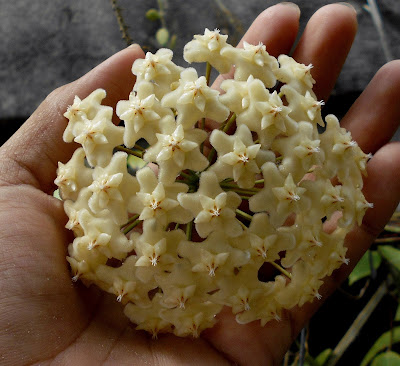
About a decade ago, some plants of a supposedly albinistic Hoya pubicalyx became available from a few orchid peddlers in the province of Quezon, and were being offered for rather exorbitant prices. Not too long thereafter, the plants were visited in its area of discovery by George Mendoza, a plant collector, and the plants he collected were sent abroad, which formed the bulk of the plants eventually propagated in Thailand, Sweden, and the US. Meanwhile, the plants were very rarely seen in its country of origin. I have been to the type locality of this species, and contrary to what was given in the protologue, the plants were not found in the town of Mauban, but in Real. Here also is the locus classicus for Begonia polilloensis . The area where Hoya celata was found in 2010 is characterized by cliffs facing the sea but is now heavily degraded due to a road being constructed, although recent visits proved that plants still persist, particularly on the higher reaches. However, si...

Graceful Crinum gracile

Image
About one-and-a-half years ago, I was given a small plant of Crinum gracile which I potted in gritty soil and placed in partial shade. The plant grew steadily, yet slowly even with regular fertilizer application, until I finally noticed a peduncle forming near the base. As with practically all crinums, the inflorescence developed rapidly, and two nights ago, the first two flowers opened, at night. Crinum gracile is one of only two native representatives of the amaryllis family ( Amaryllidaceae ) in the Philippines. It has been found in Nueva Ecija, Rizal, and Laguna provinces in Luzon, and the islands of Mindoro and Mindanao, although there seem to be no existing precise locality records for the latter two islands. It is also found in Sumatra and New Guinea. Compared to the much larger and more robust C. asiaticum which is widespread around beaches, C. gracile appears to be rare and localized plants, at least in the Philippines. As such, it is barely known in cultivation. It ...

The sweet and tiny Trachoma phillipsii

Image
I would like to lead myself into believing that I already have way too many plants, which should explain why, since November when I started seeing spent flowers of these plants, I have not seen the floral display at the height of its anthesis. But no, I think it's just a plain case of inattentiveness. Nothing more, nothing less. Because you see, Trachoma phillipsii is one of my (very) small-flowered orchids that when in bloom, are just very likely to drown unnoticed in a sea of green. I have seen batches of buds about to pop, only to miss the show and realize the boo-boo a day after, after seeing the flowers already closed. You see, the blooms, cute and attractive as they are, only last for a day. Trachoma phillipsii was described by Timothy Choltco (as Tuberolabium phillipsii ) in 2007 and was named in honor of Andy Phillips, the well-known orchidist from California and the importer of the plants from where the original description was taken. The flowers are barely a cen...

The nectar-dripper

Image
If you have been reading my posts lately particularly about Pomatocalpa bicolor ( https://jardinerongsunog.blogspot.com/2019/06/orchids-on-rocks.html ), you surely would have noticed me bitching about the rampant vine growth in a forest in the province of Laguna. Well, here's one of those vines, but one that I wouldn't mind taking over. This is Hoya meliflua , a large-leaf species with large clusters of pink flowers that turn orange. I'll explain later the change in flower color. Hoya meliflua was originally described as Stapelia meliflua by Francisco Manuel Blanco in 1837, but was moved to the genus Hoya by Elmer D. Merrill in 1918. It is found in several islands from Luzon to Mindanao and has been recorded from Indonesia as well. The species name is a concatenation of two Latin words which means 'dripping in honey'. And that is the reason why the plants is called as such- because of its dripping orange nectar that stains the flowers and drips to the groun...

Orchids on the rocks

Image
June 22, 2019- While on a solo trek in northern Laguna I saw this clump of Pomatocalpa bicolor in full bloom. I have been seeing these plants in this location since the early 2000s and when I am here at the right time, I can expect to see the plants in flower. And this day I wasn't disappointed.  Pomatocalpa bicolor is endemic to the Philippines and found in the provinces of Bataan, Benguet, Ilocos Norte, Laguna, Nueva Vizcaya, and Rizal on Luzon; Polillo off eastern Luzon; Busuanga and Palawan; Bolo, Leyte, Negros, and Romblon in the Visayas; and Agusan del Norte on Mindanao. Despite being widely distributed, the species appears to have very localized populations and therefore not often encountered. The stems attain lengths of more than 3 meters, with roots produced along the stem length. The branched inflorescences reach about 60 cm in length and bear fleshy flowers clustered at the rachis tips. The flowers are fragrant, 1.7 cm across by 2.3 cm high, usually off-white w...

Hoya verticillata flowering after... 8 years

Image
About three weeks ago I noticed a cluster of flowers in the rafters of one of my shading nets. I knew it was a Hoya , but could not identify what it was, until the individual flowers dropped off shortly thereafter. And then today while looking at my tillandsias I noticed the same cluster, this time from a peduncle that grew lower down and hence easier to reach. It was most definitely a Hoya verticillata , and when I traced the stem to the pot, I learned that, from what the tag said, it was from an acquisition in 2011, back when I still would not even attempt to know what it was, because many species of Hoya are notorious for sharing practically the same foliage. I thought it was a Hoya mindorensis  back then. Now, I know that this species is one of the most common in cultivation but two things should be mentioned here. The first is that despite being a species that is widespread in tropical Asia, it wasn't known to occur in the Philippines until botanist Danilo Tandang ...

The elegant Dendrochilum unicallosum

Image
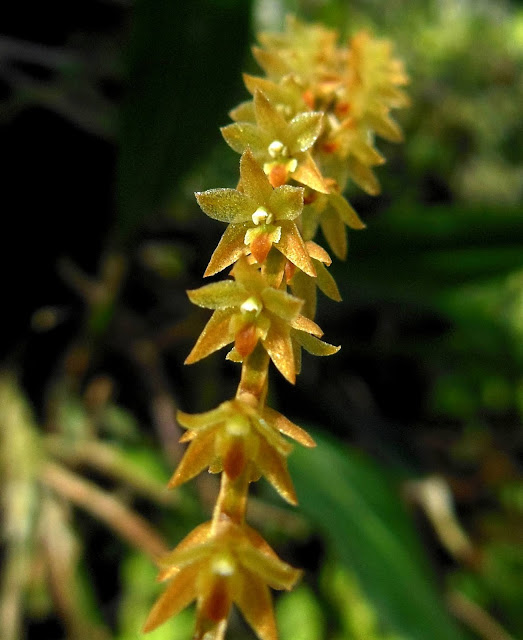
Let us be honest:  Dendrochilum deserves more recognition that it is currently being bestowed with. Despite being a diverse genus, very few species are in general cultivation and being propagated, which is a crying shame considering the many attractive virtues that other lesser known species offers to the discerning and rabid collector. So please allow me to introduce to you a little-known orchid from the genus Dendrochilum - D. unicallosum . Dendrochilum unicallosum was described by Louis O. Williams in 1937, based on fragments collected by Augustus Loher in the province of Rizal on September 1909. For a number of decades, this species remained one of the least known of Philippine dendrochilums, until plants began to appear in the trade, which is said to have come from Nueva Vizcaya on central Luzon. This   is a quite straggling plant with relatively long, curved to often pendent rhizomes which bear the pseudobulbs at 1.5 cm. intervals. These pseudobulbs are up...

The small but powerfully fragrant Hoya lacunosa

Image
As I passed by a group of ant plants and orchids one rainy morning, I caught a strong scent emanating from among the tangled vegetation of my humble plant collection and, almost obscured by one of the vandas, is a cluster of flowers from a plant of Hoya lacunosa , a plant that is frequently neglected and thrives on it. Indeed, with even the slightest care the longest stem has already passed the one-meter mark. Looking closely, I spotted several peduncles with developing buds. Some months ago, I also caught a whiff of its perfume and, seemingly forgetting which of my hoyas had such scent, it took me a few minutes to track down its source. You know you have lots of many different plants already when things like this happen. In quite a few occasions I get surprised to see a plant that I could not even recall how I got in the first place. At any rate, the scent of this species is among the strongest in the genus, relative to size. An old favorite, Hoya lacunosa was so name...

The lovely miniature orchid Trachoma phillipsii

Image
The genus Trachoma contains small monopodial orchids that are related to Tuberolabium , differing from that genus by way of their fugacious flowers that appear in batches over a progressively elongating rachis, an immoveable labellum fixed to the base of the column, a footless column, and two sessile pollinia. Similar to many other orchids with ephemeral flowers, the production of buds is triggered by an environmental stimulus i.e. a sudden drop in temperature such as after rains. The flowers of Trachoma may be short-lived, but are very attractive and often strongly fragrant. Trachoma phillipsii was described as Tuberolabium phillipsii by Timothy Choltco in 2007; Alexander Kocyan and Andre Schuiteman transferred it to Trachoma in 2014. As far as is currently known, this taxon appears to be restricted only to Nueva Vizcaya on Luzon. The plant was named after Andy Phillips, owner of Andy's Orchids in Encinitas, California and the importer of the plants from where the original...

A dendrobe with no name

Image
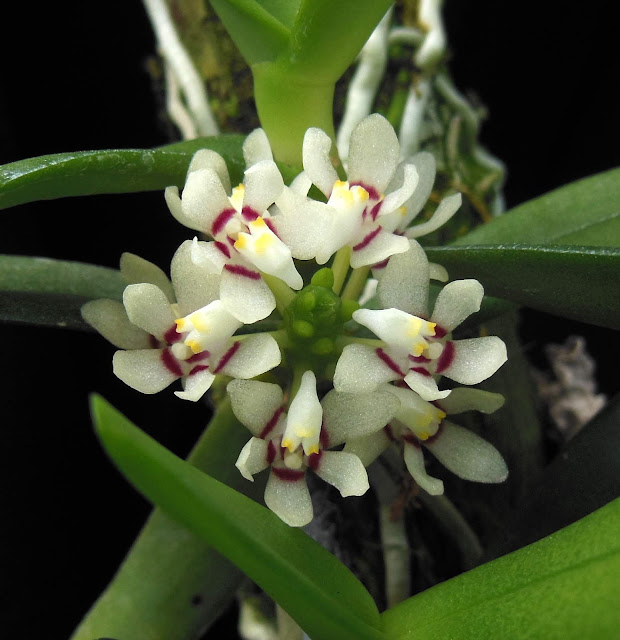
This is one of my more obscure orchids around, which I believe came to the collection as a small division about seven years ago. I have no provenance data, so I really do not know where it came from. I tried identifying it using my digital copies of Philippine orchid types, but the plant did not really match any of the dendrobes. That leaves the possibility that this is a species still unknown to science, or perhaps it also occurs from outside the Philippines. Nonetheless, this is a very easy going species, fully exposed to the elements and highly resistant to fluctuating climatic conditions. The stems have no pseudobulbous bases, but the function of storage organs is taken out by the knife-like, fleshy leaves. The upper portions of the stems are bare and on their nodes are where the small blooms are produced. This should give you an idea of the size of the flowers: The flowers do not open widely, pure white except for some purple lines on the side lobes and a dark yellow...

A plant called 'Yesterday, Today, and Tomorrow'

Image
The family Solanaceae , the so-called nightshade family, contains many very familiar edible plants which include the chili pepper ( Capsicum annuum ), eggplant ( Solanum melongena ), the potato ( S. tuberosum ), and tomato ( S. lycopersicum ); the economically important tobacco ( Nicotiana tabacum , and  N. rustica ) also belongs to this family. Well known horticulturally important representatives include the nipple plant ( S. mammosum ), and Petunia . Few genera contain fragrant flowers, and these include the angel's trumpet ( Brugmansia  ssp.), and the plant we are featuring here, Brunfelsia pauciflora* . Brunfelsia is a genus native to the neotropics and was established by Swedish botanist  Carl von LinnĂ©, in honor of German botanist Otto Brunfels, German botanist and theologian who, together with  LinnĂ©, helped develop botany in accordance to the rigors of scientific inquiry. Plants in this genus have a few species in cultivation, and are popular due to their ...