Posts

Showing posts with the label Alocasia

What exactly is an 'Alocasia pseudosanderiana'? Spoiler alert: I don't f***ing know
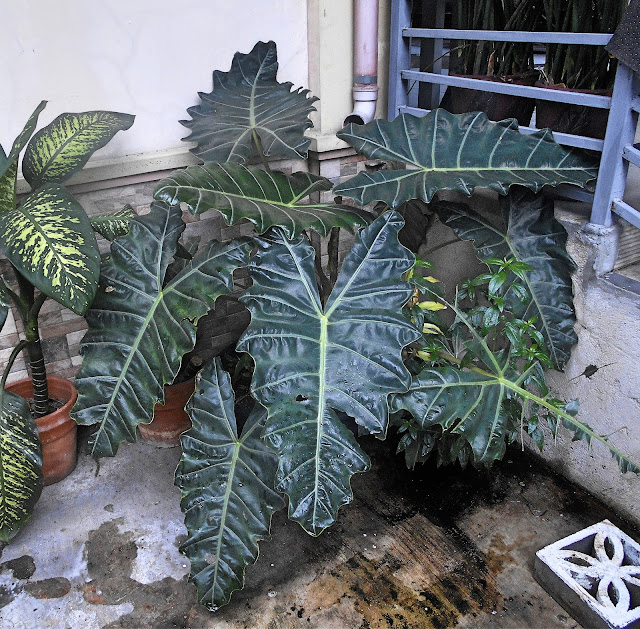
Image
 Whilst taking a stroll around the church grounds of San Jose in Nueva Ecija one early September morning, I came across this Alocasia whose identity is still steeped in a shitload of question marks. Consider: 1. No one really knows where it originally came from.  Well, probably from the Philippines. However, Dr. Lanie Medecilo did not include this plant in her studies on Philippine alocasias a few years ago. But in the same vein, it can be found growing semi-wild in some areas in the Philippines, while it has so far not been reported doing the same in neighboring regions. 2. No one knows what its exact identity is. The name ' Alocasia pseudosanderiana ' is a nomen nudum . In other words, it was established without following the rules of describing new plant species. As such, the name should not be used at all. But we do need something to refer this plant with, and ' Alocasia pseudosanderiana ' is available despite its dubious merits. But here is where it gets interestin...

My (bitchy) aroid mix

Image
 Through the years, I have experimented with a wide range of soil ingredients- from loam soil, sand, coco chunks, coco peat, burnt rice hulls... practically everything you can think of. And while these components can be suitable for most plants, the mix just won't cut it for more specialized aroids. Everyone have their own recipes that they swear their lives on. However, I have found out- through trial and error as well as years of experience- that my 'tried and tested' mixes even from just a few years ago have resulted in the demise of some choice plants. Plants that are extremely difficult to procure here in the Philippines where horticulture is not as well-developed as its neighbors. I needed a mix that would greatly minimize, if not eliminate, the odds of losing more plants. Incidentally, what I have come up with is very similar to those used by aroid growers in Europe. And by 'aroid growers', I am not referring to the mainstream crowds who like what their next ...

Alocasia vs Colocasia

Image
So what is the difference between Alocasia and Colocasia (apart from the spelling 😁)? This is one of the questions I wondered during my early years of collecting plants, and I must admit that I have interchanged both during some random discussions with other plantspeople. And while the matter has been resolved for me a long time ago, I totally understand the confusion it still brings to today's hobbyists. Unfortunately, the similarities are much more easily observed than their differences, which require scrutiny by a discerning eye, one which botanists commonly possess but not by most other mortals. Cheer up, lemme show you the way. Above: Alocasia or Colocasia ? Really, you only have to take the time to look under the leaf surfaces of your plants. Alocasia have glands situated at the axils of the midrib and the primary (main) lateral veins. These are absent in Colocasia . The fruits of both also differ. In Alocasia , the berries are large and ripen to deep orange, whereas the...

Distinguishing Alocasia boyceana, A. heterophylla, and A. ramosii, and some words about asking for plant identification

Image
  In the Philippines, three commonly encountered Alocasia species are frequently mixed with one another that identification of plants posted in social media has resulted in a muddied concept of what constitutes what, with most plants getting labeled as ' Alocasia heterophylla ' even though practically no one can elucidate why he thinks it is that species. More on that later. Still, admit I should that I, too, was confused not too long ago until I got fed up with my own ignorance and decided to undo it once and for all. I now show thee the path to thy enlightenment. The main aim of this article is to allow you to reliably identify which is which. I am going to keep this ultra-simplified, so I am not going to talk about floral morphologies. People usually don't catch them in flower anyway and very few have the inclination to save dissected inflorescence samples in an alcohol solution for later reference. The other aim, well, we'll get to that later. Alocasia heterophylla...

Alocasia sinuata in the wild

Image
A popular subject in horticulture, Alocasia sinuata is a small-growing Philippine endemic with bullate, thickly coriaceous, shiny leaves. The plants start out green then mature into a deeper green with almost metallic gray patina and with dark green sunken veins, resulting in a memorable foliage display of pure bliss. The species was described by Nicholas Edward Brown in 1885 from a cultivated specimen from Kew which was given by William Bull. The original collector of this plant is unknown. In the type sheet, Brown noted that it was collected in the 'Malay Archipelago' which Brown himself corrected to 'Philippines'. A photo of the holotype can be viewed here: http://apps.kew.org/herbcat/getImage.do?imageBarcode=K000291398 What is notable in the type specimen is the very deep sinus with rather distant posterior lobes. However, as noted by George Yao, an ardent student of Araceae in the Philippines, posterior lobing and sinus depth is variable in Alocasia anyway....

An encounter with Alocasia maquilingensis

Image
One of the larger Alocasia species endemic to the Philippines is Alocasia maquilingensis , a species superficially similar to the common and widespread A. macrorrhizos . In the field, one can easily determine this species from the latter by the downy indumentum covering the leaf undersides and petioles- you just have to touch and feel 'em! It is a very slow-growing plant that eventually forms a trunk similar to other large Alocasia species. Alocasia maquilingensis petiole with short, whitish 'hairs'. I found these plants on Mt. Makiling, the plant's namesake, while hiking with my friend Noel Malacad and his two sons. These plants are found only at a narrow altitudinal band and occur mostly with Elatostema , Schismatoglottis , and rattan ( Calamus spp.). This species is not in general cultivation; I don't maintain even a single plant. Alocasia maquilingensis , despite its subtle tactile qualities that some might find intriguing, has very exacting ecologi...

The tall, 'tattered', and splendid Alocasia portei

Image
One of those plants that I usually see and admire from my frequent hikes around my area is Alocasia portei , a large-growing aroid that can be quite common where they occur. There are apparently two forms known to exist, one with plain green leaves and greenish petioles with thin bandings and the other with pale green veining with petioles that eventually become very dark, and whose juvenile plants bear striking resemblance to A. sanderiana . Both forms are found naturally in the mountains within my area, but their populations do not seem to overlap. In the wild, A. portei  appears to favor more exposed sites such as road embankments and trails, with leathery leaves that are held sub-erect and gives the impression of reaching out into the light. Really old individuals eventually develop a thick stem in the same manner as those found on the more common and widespread A. macrorrhizos , and truly spectacular examples reach to about 3 meters in height and have practically b...

How deforestation decimated my plant collection

Image
Kohleria hybrid What does forest deforestation have to do with losing plants in my collection? Over the years I have managed to expand the plant collection in waves- many were obtained either via trades or given as gifts, or simply bought. This was a time when I was as rabid a collector as anyone could possibly be, a time when I always had my eyes set on a plant or two and will seek out anyone who happened to have that plant I want. Now, as many of you probably already know, I have made it a habit of trekking into forests to observe plants in their natural habitats and fortunately, there is one within my area, although much of the old growth has already been harvested way even before I was born. But on my later visits, I was appalled by the sudden influx of charcoal producers- trees were being cut down and land being razed to the ground to make way for coal production. And this was particularly troubling because this forest is one of the two sources of water for our town. It wa...