Posts

Showing posts with the label orchids

"What variety is that?", and why it's a question that doesn't make sense (most of the time).
Image
 I frequently see and hear people say "this variety of plant is...", when what they were really wanting to say was "this kind of plant is...". I hear it so much, especially on Youtube videos, that it gives me the impression that these people were only substituting the word 'variety' for 'kind' because they are perhaps assuming that 'variety' is a botanical jargon for 'kind' or 'type'. Even Summer Rayne Oakes, despite her exposure to various botanists from around the world, is still inclined to say "variety", rather than the much more apt 'species'.  Variety You see, 'variety' in the botanical language does not equate to 'kind' or 'type'. It is a botanical nomenclature ranking. To illustrate: genus-species-subspecies-variety-forma . In the botanical world, the distinction between subspecies and variety is sketchy at best, and one botanist's definition of 'subspecies' may be ...

The 'other' fire orchid

Image
Renanthera - those orchids that know only yellows, oranges, and, more prominently, megawatt reds. Among the red-flowered species, the one that is most often discussed is R. storiei ; rightfully so, because this species bear some of the most saturated reds anyone can ever see on any orchid, whether natural or man-made. However, less often given credit for is R. philippinensis - a smaller species, but equally capable of producing the most incandescent reds.  Renanthera philippinensis was originally described as a variety of R. storiei by both Oakes Ames and Eduardo Quisumbing in 1932. Five years later, Louis O. Williams elevated the taxon to species rank, saying "There is no doubt but that Renanthera philippinensis is quite distinct from Renanthera storiei Reichb.f. Ames and Quisumbing pointed out in the original description of R. storiei var. philippinensis that the type of their varietal concept differs radically from the species in its small stature, small leaves and flowers, ...

The sweet and tiny Trachoma phillipsii

Image
I would like to lead myself into believing that I already have way too many plants, which should explain why, since November when I started seeing spent flowers of these plants, I have not seen the floral display at the height of its anthesis. But no, I think it's just a plain case of inattentiveness. Nothing more, nothing less. Because you see, Trachoma phillipsii is one of my (very) small-flowered orchids that when in bloom, are just very likely to drown unnoticed in a sea of green. I have seen batches of buds about to pop, only to miss the show and realize the boo-boo a day after, after seeing the flowers already closed. You see, the blooms, cute and attractive as they are, only last for a day. Trachoma phillipsii was described by Timothy Choltco (as Tuberolabium phillipsii ) in 2007 and was named in honor of Andy Phillips, the well-known orchidist from California and the importer of the plants from where the original description was taken. The flowers are barely a cen...

Orchids on the rocks

Image
June 22, 2019- While on a solo trek in northern Laguna I saw this clump of Pomatocalpa bicolor in full bloom. I have been seeing these plants in this location since the early 2000s and when I am here at the right time, I can expect to see the plants in flower. And this day I wasn't disappointed.  Pomatocalpa bicolor is endemic to the Philippines and found in the provinces of Bataan, Benguet, Ilocos Norte, Laguna, Nueva Vizcaya, and Rizal on Luzon; Polillo off eastern Luzon; Busuanga and Palawan; Bolo, Leyte, Negros, and Romblon in the Visayas; and Agusan del Norte on Mindanao. Despite being widely distributed, the species appears to have very localized populations and therefore not often encountered. The stems attain lengths of more than 3 meters, with roots produced along the stem length. The branched inflorescences reach about 60 cm in length and bear fleshy flowers clustered at the rachis tips. The flowers are fragrant, 1.7 cm across by 2.3 cm high, usually off-white w...

Vrydagzynea hiding in plain sight

Image
Now I must admit that I was in this same exact spot about two weeks ago and did not notice these plants. And I'm pretty sure that it's because about two weeks ago, the plants were just beginning to form their capitate (head-like) inflorescences. The white flowers made the difference. And you would be forgiven if you think that these are just some obscure 'weed' but it's actually an orchid. I know, I know. These do not look like they are orchids at all, but they are. When I first saw one, I thought I was looking at a Tropidia , another orchid that doesn't look like an orchid. Nevertheless, this is a species of Vrydagzynea , which belongs to the group commonly called the 'jewel orchids' for their shimmering, patterned leaves. Three species are known from the Philippines, but these plants differed mostly by their lance-shaped leaves and more contracted inflorescences. In fact, it is most similar to a species known from outside the archipelago, V. la...

Ludisia ravanii untold

Image
November 10, 2007- While admiring a population of Crepidium bancanoides on the forest floor in a national park in eastern Luzon, I heard one of my companions, Ernie Alvaran, summoning me. " Ludisia !" he yelled. When he said the word I knew we're onto something. Merlin Sy, another companion, found more plants. During this time, the genus Ludisia was monotypic, or consisting of only one species, L. discolor . The species is widespread and occurs from India eastwards to Indochina and southwards to Indonesia. There is a record from Palawan but it seems that no one has found the plants since. So if what Ernie found was L. discolor , then that would be the first record of this species occurring on Luzon. While taking photos of some of the plants, which were sterile, Ernie told me that earlier that month he saw and bought a few plants that were said to have come from central Luzon, bearing the same small leaves of the plants before us. At that moment I was thinking of ...

A 'cleaner' Phalaenopsis stuartiana

Image
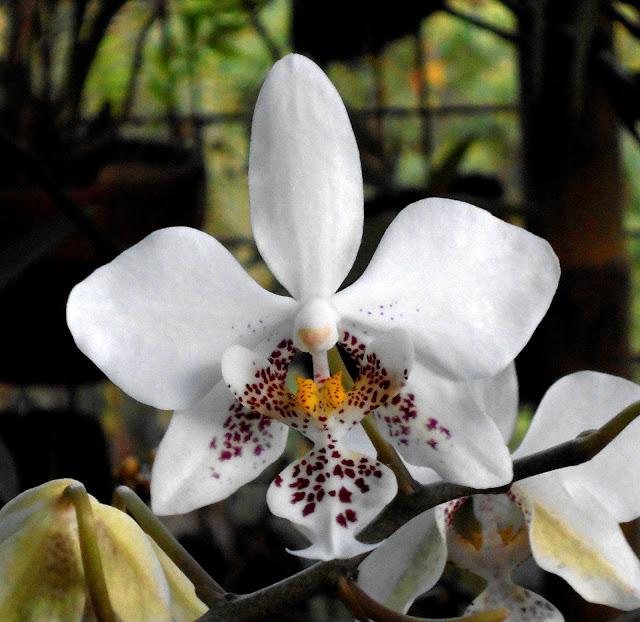
Okay, tell me how many times you have seen something like this. Typically for Phalaenopsis stuartiana , the inner halves of the lateral sepals and the labellum midlobe are pale yellow overlaid with dark maroon spots. One of my plants here of this species deviates from the norm by exhibiting no such yellow coloration, the yellow being confined only to the callus and the labellum side lobes, resulting in a 'cleaner' look. Compared to many other stuartianas, this clone begins its flowering period by producing a batch of few buds, with the rachis elongating progressively with more flowers.  Don't read me wrong: I like even normal stuartianas, but I just can't deny that the more ascetic look of this one has a more, shall I say, regal air to it. Can't wait for more of those flowers!

The story of the orchid Flickingeria praetermissa

Image
Back in 2006, I was given a digital copy of Philippine orchid types kept at the Oakes Ames herbarium in Harvard by slain botanist Leonardo L. Co and trying to match Philippine orchid checklists at that time, I noticed that there was a sheet named Dendrobium forcipatum , an unpublished name attributed to Oakes Ames.  Further investigation revealed that Ames gave the name Dendrobium forcipatum to the specimens collected by C.A. Wenzel (Wenzel 65) in Dagami, Puguahaan, Leyte in May 17, 1913 but apparently did not publish a description paper; there is not even a record of the name in Index Kewensis nor at the International Plant Names Index. Later in 1920, J.J. Smith described a plant that was in cultivation in Bogor, Java, Indonesia, but of unknown provenance and named it as Dendrobium forcipatum J.J. Smith , which is now considered to be conspecific with Flickingeria appendiculata (Bl.) Hawkes (Seidf., 1980) and is clearly not identical to Ames’ plant. Now let's take a step back....

What is the real identity of Phaius antoninae?

Image
In 2011, Peter Balzer described a new Phaius species as P. antoninae , in honor of his wife Antonina. The new species was compared to P. tankervilleae , and differing from it mainly by way of the sepals and petals being longer than the labellum. In 2017, Judi V. Stone and Phillip J. Cribb absorbed it as a variety of P. tankervilleae , as P. tankervilleae var. antoninae , a decision that stands to this day. I have been keeping this species/variety for quite some years already and find it to be a very accommodating and fast-growing plant. Upon maturity of the leaves, tall inflorescences appear as sure as the sun is going to rise tomorrow. As problem-free as these plants are, I have one hang-up: the flowers stay limp instead of opening and advertising themselves up proudly, which is a shame because these are by no means small flowers. If only those blooms will shave away some of their shyness then what a show they would make. Additionally, those blossoms emit a scent simil...

Phalaenopsis schilleriana and P. stuartiana as one species?

Image
Recently, my attention was drawn to an article which appeared at the Manila Bulletin dated May 2, 2017 and authored by Jim Cootes and Ronny Boos, two personalities whose names are frequently mentioned with regards to the study of orchids in the Philippines. In that article, it was implied that Phalaenopsis schilleriana and P. stuartiana may possibly be one species, with the latter being a variant, as the former was earlier described. It's been years since I talked to these authors about orchids, but if the reverse was true, then I would have advised them that such a supposition is, well, quite absurd. But first, here is a link to the said article: https://newsbits.mb.com.ph/2017/04/30/the-curious-case-of-phalaenopsis-schilleriana-and-phalaenopsis-stuartiana/?fbclid=IwAR1BMepvNb0W8_ckMBDohUNTMkVaonQY1oxs7bJNDf6v8R2xxbuAUJ3mRHk What I did notice at the said article is that the authors failed to take into consideration the shape of the callosities of both species, and their disti...

An orchid weed: Spiranthes sinensis

Image
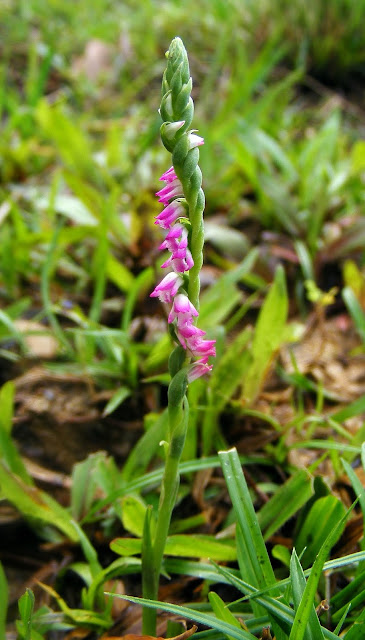
Some orchids have extremely restricted ranges, being only found in one very specific site in just one mountain, and on the other end of the extreme are those that occur in vast swathes of territory- and I mean VAST. The plant we have here is one such species, with a range that can almost be described as ridiculous. Ladies and gents, meet Spiranthes sinensis . How widespread is Spiranthes sinensis ? It has been recorded from India, Nepal, and Sri Lanka, Afghanistan, China across mainland Southeast Asia (Afghanistan, Bhutan, Kashmir, and Mongolia), Siberia, Japan, the Ryukyu Islands, Taiwan, Korea, Peninsular Malaysia, Sumatra, Java, Borneo, Sulawesi, the Lesser Sunda Islands, East Timor, the Moluccas, New Guinea, the Solomon Islands, Vanuatu, Samoa, Niue, Northern Australia, Tasmania, New Caledonia and New Zealand. Whew. In the Philippines, this species has been found in Ifugao, Benguet and Mountain Province on Luzon, the island of Dinagat, and Agusan (exact provinces no...

The elegant Dendrochilum unicallosum

Image
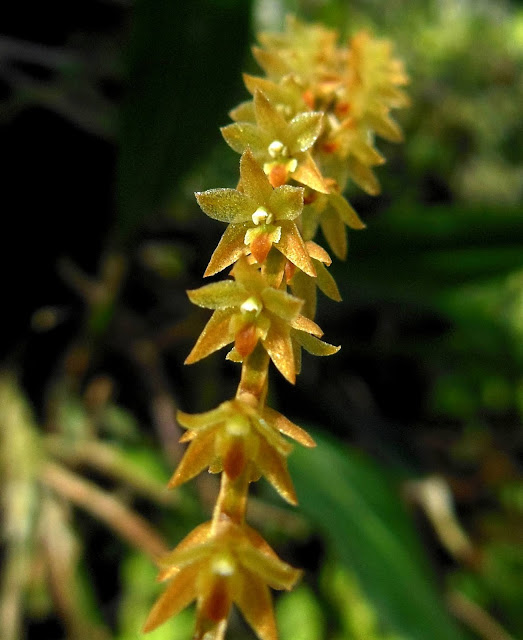
Let us be honest:  Dendrochilum deserves more recognition that it is currently being bestowed with. Despite being a diverse genus, very few species are in general cultivation and being propagated, which is a crying shame considering the many attractive virtues that other lesser known species offers to the discerning and rabid collector. So please allow me to introduce to you a little-known orchid from the genus Dendrochilum - D. unicallosum . Dendrochilum unicallosum was described by Louis O. Williams in 1937, based on fragments collected by Augustus Loher in the province of Rizal on September 1909. For a number of decades, this species remained one of the least known of Philippine dendrochilums, until plants began to appear in the trade, which is said to have come from Nueva Vizcaya on central Luzon. This   is a quite straggling plant with relatively long, curved to often pendent rhizomes which bear the pseudobulbs at 1.5 cm. intervals. These pseudobulbs are up...