Posts

Showing posts with the label Hoya

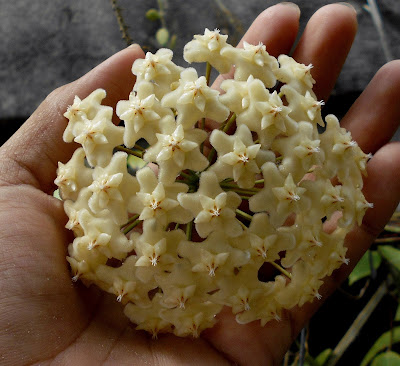
A white, 'salty' Hoya
Image
About a decade ago, some plants of a supposedly albinistic Hoya pubicalyx became available from a few orchid peddlers in the province of Quezon, and were being offered for rather exorbitant prices. Not too long thereafter, the plants were visited in its area of discovery by George Mendoza, a plant collector, and the plants he collected were sent abroad, which formed the bulk of the plants eventually propagated in Thailand, Sweden, and the US. Meanwhile, the plants were very rarely seen in its country of origin. I have been to the type locality of this species, and contrary to what was given in the protologue, the plants were not found in the town of Mauban, but in Real. Here also is the locus classicus for Begonia polilloensis . The area where Hoya celata was found in 2010 is characterized by cliffs facing the sea but is now heavily degraded due to a road being constructed, although recent visits proved that plants still persist, particularly on the higher reaches. However, si...

The nectar-dripper

Image
If you have been reading my posts lately particularly about Pomatocalpa bicolor ( https://jardinerongsunog.blogspot.com/2019/06/orchids-on-rocks.html ), you surely would have noticed me bitching about the rampant vine growth in a forest in the province of Laguna. Well, here's one of those vines, but one that I wouldn't mind taking over. This is Hoya meliflua , a large-leaf species with large clusters of pink flowers that turn orange. I'll explain later the change in flower color. Hoya meliflua was originally described as Stapelia meliflua by Francisco Manuel Blanco in 1837, but was moved to the genus Hoya by Elmer D. Merrill in 1918. It is found in several islands from Luzon to Mindanao and has been recorded from Indonesia as well. The species name is a concatenation of two Latin words which means 'dripping in honey'. And that is the reason why the plants is called as such- because of its dripping orange nectar that stains the flowers and drips to the groun...

Hoya verticillata flowering after... 8 years

Image
About three weeks ago I noticed a cluster of flowers in the rafters of one of my shading nets. I knew it was a Hoya , but could not identify what it was, until the individual flowers dropped off shortly thereafter. And then today while looking at my tillandsias I noticed the same cluster, this time from a peduncle that grew lower down and hence easier to reach. It was most definitely a Hoya verticillata , and when I traced the stem to the pot, I learned that, from what the tag said, it was from an acquisition in 2011, back when I still would not even attempt to know what it was, because many species of Hoya are notorious for sharing practically the same foliage. I thought it was a Hoya mindorensis  back then. Now, I know that this species is one of the most common in cultivation but two things should be mentioned here. The first is that despite being a species that is widespread in tropical Asia, it wasn't known to occur in the Philippines until botanist Danilo Tandang ...

The small but powerfully fragrant Hoya lacunosa

Image
As I passed by a group of ant plants and orchids one rainy morning, I caught a strong scent emanating from among the tangled vegetation of my humble plant collection and, almost obscured by one of the vandas, is a cluster of flowers from a plant of Hoya lacunosa , a plant that is frequently neglected and thrives on it. Indeed, with even the slightest care the longest stem has already passed the one-meter mark. Looking closely, I spotted several peduncles with developing buds. Some months ago, I also caught a whiff of its perfume and, seemingly forgetting which of my hoyas had such scent, it took me a few minutes to track down its source. You know you have lots of many different plants already when things like this happen. In quite a few occasions I get surprised to see a plant that I could not even recall how I got in the first place. At any rate, the scent of this species is among the strongest in the genus, relative to size. An old favorite, Hoya lacunosa was so name...

How deforestation decimated my plant collection

Image
Kohleria hybrid What does forest deforestation have to do with losing plants in my collection? Over the years I have managed to expand the plant collection in waves- many were obtained either via trades or given as gifts, or simply bought. This was a time when I was as rabid a collector as anyone could possibly be, a time when I always had my eyes set on a plant or two and will seek out anyone who happened to have that plant I want. Now, as many of you probably already know, I have made it a habit of trekking into forests to observe plants in their natural habitats and fortunately, there is one within my area, although much of the old growth has already been harvested way even before I was born. But on my later visits, I was appalled by the sudden influx of charcoal producers- trees were being cut down and land being razed to the ground to make way for coal production. And this was particularly troubling because this forest is one of the two sources of water for our town. It wa...