Posts

Last words for this year

Image
During the closing days of 2019 and all the years before it that I can remember, there was no shortage of wishes for a better new year. I won't be telling you about my hopes for the coming year because, to be honest, I have none. Human will and wants are inconsequential in this great cog of events that happen simply because they happen. Was 2020 really THAT bad? Or is it only a trick of false perspective because most of us weren't yet alive when those great wars laid down immeasurable misery and that there is no way of knowing if the coming years would be worse? Whether we admit it or not, it only gets more and more dreadful each passing year. Calamities are increasing in frequency and destructive power and the degradation of human behavior translates to new lows which we never thought we'd witness a mere few years before. And, everybody dies. Whether he's an athlete for the ages or your next door bum, everybody is heading towards that inevitable finality. It's all ...

Alocasia vs Colocasia

Image
So what is the difference between Alocasia and Colocasia (apart from the spelling 😁)? This is one of the questions I wondered during my early years of collecting plants, and I must admit that I have interchanged both during some random discussions with other plantspeople. And while the matter has been resolved for me a long time ago, I totally understand the confusion it still brings to today's hobbyists. Unfortunately, the similarities are much more easily observed than their differences, which require scrutiny by a discerning eye, one which botanists commonly possess but not by most other mortals. Cheer up, lemme show you the way. Above: Alocasia or Colocasia ? Really, you only have to take the time to look under the leaf surfaces of your plants. Alocasia have glands situated at the axils of the midrib and the primary (main) lateral veins. These are absent in Colocasia . The fruits of both also differ. In Alocasia , the berries are large and ripen to deep orange, whereas the...

Leonardo Co and Mycaranthes leonardoi

Image
In late 2008, botanist Ulysses Ferreras approached and asked me if I could assist him in describing two orchid species that he found, with a very special request: that one of the two will be named after Leonardo Co. The orchids in question were from two genera, Mycaranthes and Robiquetia , and Uly suggested that the latter bear Leonard's name. I expressed disagreement, arguing that doing so would rob the orchid of identity because it will then carry the name of two persons- an idiosyncrasy on my part, I must admit. So we ended up with the combination of ' Mycaranthes leonardoi ', with the Robiquetia bestowed with the name of ' Robiquetia enigma '. At this point, I would like to draw attention to the fact that during my active years in orchidology, I have made it a matter of principle to keep to a minimum the number of people I would like to honor in my species descriptions, and that these people should have had at least some direct involvement in these species. Leo...

Pothos dolichophyllus in habitat

Image
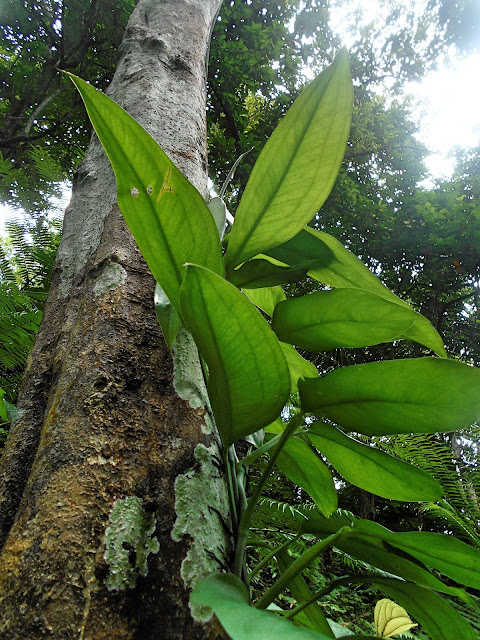
Like an old buddy who I'd like to visit every now and then, these wild Pothos dolichophyllus have become a much-favored plant too see every time I take one of those many silent hikes. Yep, an old buddy that requires you to clamber up cliffs 😅 Most of you might be familiar with the so-called ' Pothos ' in cultivation, but those really are variations and cultivars of the commonly cultivated Epipremnum aureum . True Pothos are unrelated and very seldom seen in cultivation: most, if not all, species are true jungle plants that require forest conditions and can be notoriously difficult to root from cuttings.   Now, some of you might remark the Anthurium -ish foliage, particularly the veining. It's because both Anthurium and Pothos are relatives: they belong to the aroid subfamily Pothoideae . While Anthurium is Neotropical and contains the largest assemblage of species of any aroid genus, both Pothos and Pothoidium are Old World representatives of the subfamily. Pothos d...

Distinguishing Alocasia boyceana, A. heterophylla, and A. ramosii, and some words about asking for plant identification

Image
  In the Philippines, three commonly encountered Alocasia species are frequently mixed with one another that identification of plants posted in social media has resulted in a muddied concept of what constitutes what, with most plants getting labeled as ' Alocasia heterophylla ' even though practically no one can elucidate why he thinks it is that species. More on that later. Still, admit I should that I, too, was confused not too long ago until I got fed up with my own ignorance and decided to undo it once and for all. I now show thee the path to thy enlightenment. The main aim of this article is to allow you to reliably identify which is which. I am going to keep this ultra-simplified, so I am not going to talk about floral morphologies. People usually don't catch them in flower anyway and very few have the inclination to save dissected inflorescence samples in an alcohol solution for later reference. The other aim, well, we'll get to that later. Alocasia heterophylla...

A first stab at Bucephalandra

Image
In a bid to rekindle the lost fire between myself and aquatic plants, I recently placed an order for some bucephalandras- a perfect choice I reckon, given my interest in both aroids and aquatic plants. Now, despite experience in maintaining a wide range of aquatics, admit I must that I have never yet tried my hands on any Bucephalandra . That changes today. Bucephalandra 'S Blue' Now, I know I said 'aquatic plants' and all, but maybe I should establish at the onset that I intend to maintain the plants in an emersed state. I do have tanks, but I am not yet willing to take the full aquatic gardening plunge, so to speak. That will come much later. Potting up the plants is straightforward and done exactly with the same methods as outlined in a previous post about Cryptocoryne . But for the lazy, I only used repurposed containers with gravel beneath, topped by filter wool and overlaid with a layer of activated carbon, then topped again by filter wool.  The deepest layer con...

Confessing contentment

Image
I have been wanting to write down my mind since four days ago, but could not even begin to find the words to pave it all up. Then just this morning, one of my followers on my Facebook page- Jardinerong Sunog Blogs- sent me a message informing me that in just a few days, my followers have jumped from 495 to 710. The page was started two years and a month ago as the Facebook arm of this blog where I can write short pieces about plants. And as far as pages go, the following is tiny. Facebook has been pressuring me into boosting my posts so I can have more Likes and followers. I don't need those. They will come in their own time, I thought. Because I have always thought that gardening and all things that revolve around it, take time. Gardeners and the plants they nurture are children of time, and peace, and solitude. At least that is what I thought it was. The global pandemic has spawned new gardeners, but many do not want time to take its course. Thus, the inner peace that gardening i...